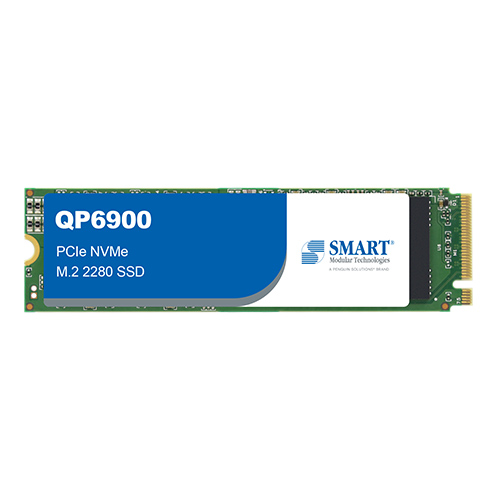
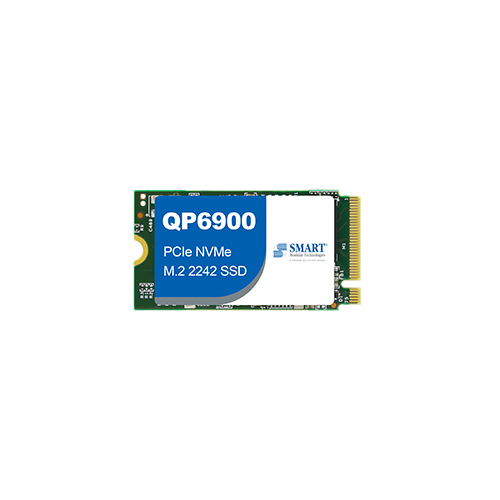
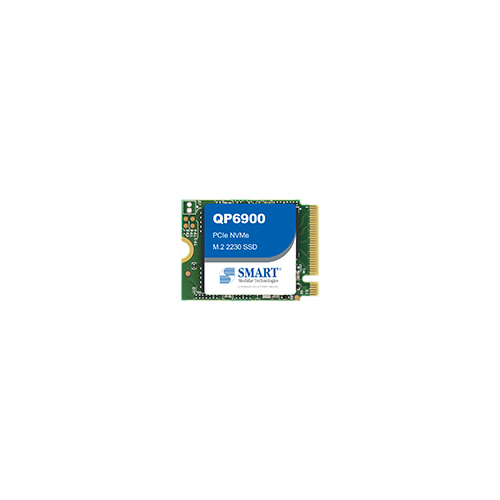
QP6900 | PCIe NVMe | M.2 2230 SSD

Buy Now
Sales Inquiry
Product Brief

SMART’s QP6900 PCIe NVMe M.2 SSD product family targets the needs of enterprise and industrial OEMs, specifically in server, networking, and data communications applications that require reliable embedded SSDs for boot, OS, application software, and data storage. Utilizing an industry standard PCIe Gen4 x4 interface and NVMe 2.0 compliant protocol, the QP6900 SSDs can easily be integrated into a host system without any special BIOS modifications or additional device drivers.

As Self-Encrypting Drives (SEDs) with hardware AES-256 encryption and TCG Opal 2.01 support, the QP6900 PCIe NVMe M.2 SSDs address the need for enhanced reliability by incorporating advanced LDPC ECC and end-to-end data path protection.
Request Datasheet
Request Sample
Downloads
No items found.
No items found.

Ordering Information

Buy Now
Sales Inquiry

Part Number

Capacity

Note

SRMP3120GTCS6AM1
120GB
C-Temp (0˚C to +70˚C)
SRMP3240GTCS6AM1
240GB
C-Temp (0˚C to +70˚C)
SRMP3480GTCS6AM1
480GB
C-Temp (0˚C to +70˚C)

Product Details

Buy Now
Sales Inquiry

Essentials

Product Series
QP6900
NAND Flash Technology
3D TLC
Interface
PCIe Gen4 x4

Performance

Sequential Read (maximum)
Up to 2600MB/s
Sequential Write (maximum)
Up to 2400MB/s
4K Random Read (maximum)
Up to 420K IOPS
4K Random Write (maximum)
Up to 550K IOPS
Capacities
120GB 240GB 480GB

Reliability

TBW
120GB: 70TBW 240GB: 170TBW 480GB: 350TBW (JEDEC® Enterprise Workload)
MTBF
> 2,000,000 hours

Environmental

Shock
-
Vibration
-
Operating temperature
C-temp: 0℃ to +70℃
Storage Temperature
-40°C to +85°C
Humidity
-

Physical

Length
30mm
Width
22mm
Height
2.23mm

Technologies

Buy Now
Sales Inquiry
Advanced Error Detection & Correction

SMART’s Advanced Error Detection & Correction technology reinforces the ECC (Error Code Correction) engine and utilizes RAID (Redundant Array of Independent Disks) mechanism. Data is reconstructed by the prior stored parity in other pages. The recovered data will be stored in a new block, and the prior stored block will be refreshed.

AES-256 Encryption
AES-256 Encryption

Advanced Encryption Standard (AES) is a hardware-based encryption method for converting data from an unencrypted into an encrypted format. 256 bits encryption key length makes it virtually impossible to decrypt the data without the original key.

Anti-Sulfur Resistor

Exposure to sulfur dioxide causes a corrosive reaction when silver alloys encounter sulfur gasses or liquid. This typically decreases resistor conductivity and thus increases failure risks. SMART uses ASRs (Anti-Sulfur Resistors) when needed for SMART-built products, allowing them to operate reliably in harsh sulfur-rich environments to meet the highest industrial standards.

End-to-End Data Protection

End-to-End Protection ensures data is correctly transferred at every data transfer point within an SSD by utilizing Error Correction Code (ECC) and additional protection mechanisms, such as Cyclic Redundancy Check (CRC), to detect and rectify errors.

Over-Provisioning
Over-Provisioning

Over-Provisioning is a technology where a certain portion of the physical capacity of the memory is reserved for carrying out garbage collection, wear-leveling, and bad block management. It effectively reduces the attribute of write amplification and extends the lifespan of an SSD.

S.M.A.R.T.
S.M.A.R.T.

S.M.A.R.T. is a self-monitoring system that prevents risks from unscheduled downtime by monitoring and displaying critical drive information. The indicators includes the drive’s health, status, usage info and potential disk problems.

TCG Opal 2.0
TCG Opal 2.0

Trusted Computing Group (TCG) Storage Work Group created the Opal Security Subsystem Class (SSC) as one class of security management protocol for storage devices. It is the most recognized standard for self-encrypting drives (SEDs). SMART offers TCG Opal 2.0 compliant self-encrypting SSDs incorporating AES encryption for rock-solid data protection.

TRIM Command
TRIM Command

TRIM is a command with the help of which the operating system can tell the SSD which blocks are no longer needed and can be deleted, or are marked as free for rewriting. With the TRIM command, it not only reduces the Write Amplifier Factor (WAF) but also boost the data access speeds.

Button Text

Solutions

Buy Now
Sales Inquiry

Along with increasing amount of IT devices and systems installed in modern enterprises, more and more data is generated and transported everyday between physical equipment and virtual spaces, like the cloud. In order to efficiently and effectively store and manage these quantities of data, it’s becoming necessary to build a data infrastructure that can accommodate in-house data centers or that can be outsourced to cloud service providers. Whether the data infrastructure is internal or external, the main purpose is to gather process and store the data under stable and secure conditions to ensure uninterrupted operation for the enterprises.

From small industrial components deployed in automation systems to large equipment used for oil drilling, project operations are asked to provide precise instructions, occasionally in harsh environments. Therefore, it is critical to maintain the accuracy of data output in addition to maintaining continuous, stable operating performance.

With the rapid rise of IoT and IIoT, the demand for connectivity has transformed networking. Today’s networks are scaling at an exponential rate, processing huge amounts of data that are stored for analysis. Reliable, proven memory is vital to ensure the hyper-fast transmission of all that data, as well as storage of the data exchanged between edge devices and network hubs. Whether the scale of network is between two locations or built for thousands of connected devices in different places around the world, there will be huge amounts of data constantly being processed whenever the network is running. That is why the right memory solutions are so important – to ensure data will be processed quickly and stored securely regardless of the demand placed on the network.

Whether it’s a mid-size health insurance company or a large-scale e-commerce service provider, storage servers play an important role in terms of data management for any business operation. Along with the increasing amounts of data generated and transported through network connections, it’s crucial to efficiently process and store the data, while enabling data access, yet maintaining security. Whatever the use or data applications, storage servers can are used where a large amount of data is transmitted, gathered and processed for analysis and business operations.

Button Text

Product Family Overview

Technical Resources & Guides

Button Text
Data flow rendering
Request a Callback

Talk to the Experts at Penguin Solutions

Reach out today and discover our level of technical expertise and customer support which continues to be an industry differentiator among memory manufacturers.

Let's Talk