Your organization has invested millions in GPU clusters, expecting peak performance to power critical AI initiatives. Yet beneath the complex hardware infrastructure and substantial capital expenditures lies an urgent question: Are you truly maximizing ROI from your AI infrastructure investment—or, are you missing out on significant computational power due to hidden performance gaps?
AI infrastructure performance isn't just about having the latest hardware. Consider this scenario: Your enterprise operates a 100-GPU cluster, but only 80 GPUs perform optimally. And suppose those 80 units run at 70% efficiency, hindered by communication delays and thermal constraints. The result? Your effective capability drops to just 56% of your infrastructure investment.
As these clusters move from experimentation to large-scale training, inference, and customer-facing AI services, those hidden gaps shift from a throughput concern to a direct threat to SLAs, user experience, potential revenue impact, and the return on your infrastructure investment.
The Hidden Performance Issues in GPU Infrastructure
These performance losses, though technical in nature, amount to strategic threats. As AI becomes increasingly central to innovation and competitiveness, organizations that fail to optimize GPU cluster performance put themselves at a real disadvantage. For IT leaders, driving peak AI infrastructure performance is critical to deliver innovation and business results.
1. GPU Failures Outpace Traditional Hardware by Orders of Magnitude
When it comes to GPU cluster performance, reliability is a defining challenge. Traditional server farms may experience occasional CPU failures, but GPUs work under extreme operating conditions that accelerate degradation.
Meta’s research on production AI clusters highlights the scope of this crisis. In a study of 16,384 GPUs and 2,000-2,500CPUs over 54 days, GPU-related failures occurred 34 times more often than CPU failures. GPUs run closer to thermal and electrical limits, generating much more heat—300-700W per GPU versus 150-350W per CPU.
Standard IT processes simply aren’t designed for failure rates of this magnitude. The synchronous nature of AI workloads makes things worse: A single GPU failure can halt an entire node and force restarts, multiplying productivity loss across the compute infrastructure.
2. The Straggler Effect: When One Slow GPU Drags Down Your Entire Cluster
AI infrastructure optimization is essential because the system is only as strong as its weakest component. Synchronous parallelism means every GPU must finish its workload before the cluster advances. Just one underperforming GPU, whether due to bad memory, firmware issues, weak networking, or overheating, can create a serious bottleneck.
Imagine a convoy on a highway. The speed of your journey is limited by the slowest vehicle. In the same way, a single “straggler” GPU reduces your cluster’s throughput and stretches out training times, which impacts project delivery schedules and drives up operational costs.
3. Silent Performance Degradation: The Invisible Threat
Standard GPU optimization monitoring tools can leave you blind to hidden, costly issues. For example, GPU thermal throttling often occurs undetected; your diagnostics may report “healthy” nodes while your entire cluster’s performance quietly erodes.
These “fail-slow” incidents—transient slow nodes or links—are hard to detect but can drastically impact GPU cluster performance, stalling time-to-insight and undermining AI infrastructure ROI.
Metrics like Model FLOPs Utilization (MFU) reveal the impact: Inefficiencies from GPU thermal throttling, communication lags, and power limit constraints waste compute cycles you’ve already paid for—materially reducing effective GPU utilization. Detecting these failures reliably requires telemetry drawn directly from the hardware layer, rather than software-level signals that often report a degraded node as healthy.
Advanced AI Infrastructure Optimization with Software
To address these pain points, you need more than standard cluster monitoring. Proactive, purpose-built solutions are key for real-time GPU monitoring, comprehensive analytics, and rapid remediation—all crucial for maximizing GPU cluster performance and ROI.
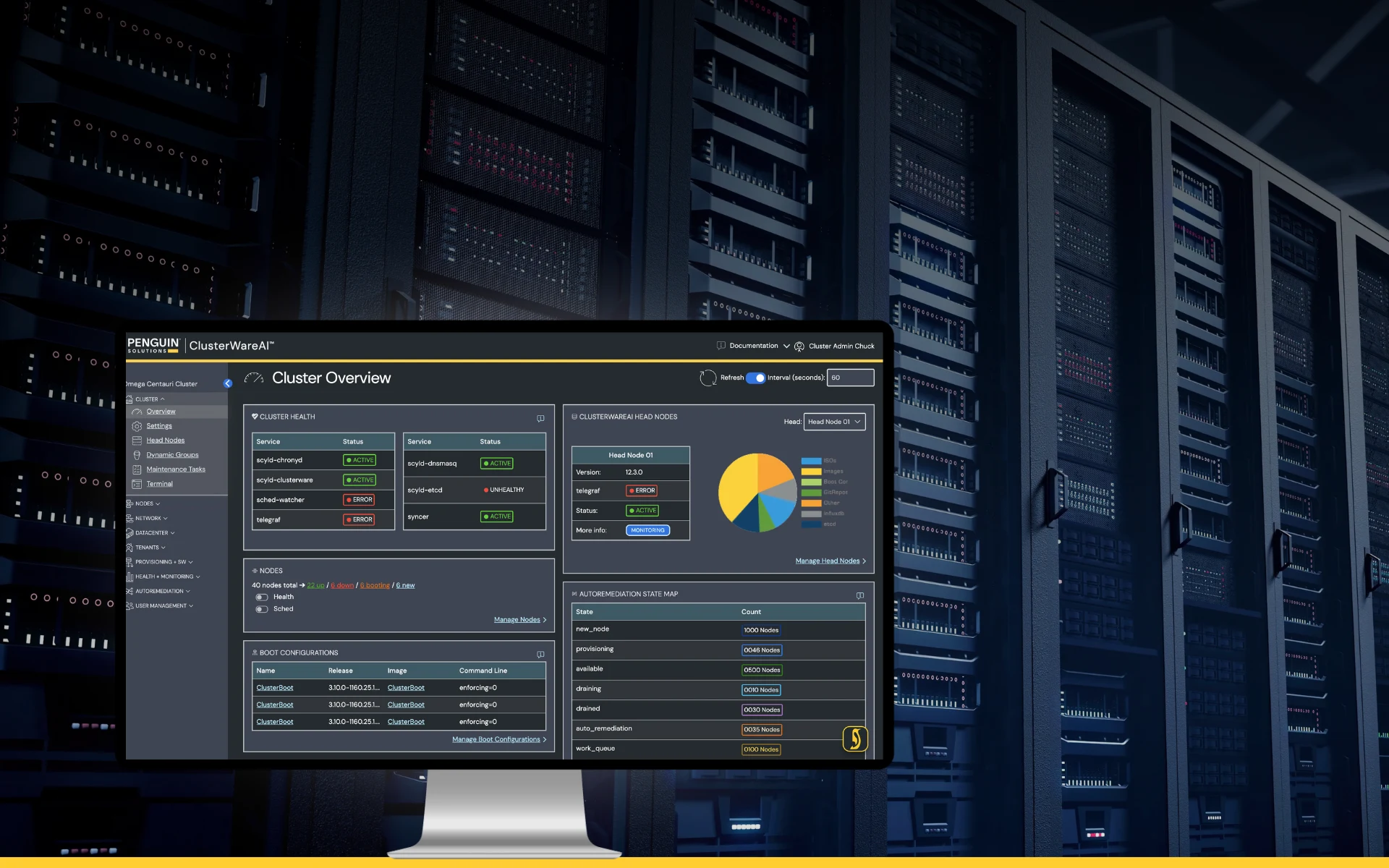
Penguin Solutions ClusterWareAI™ AI Factory Platform operating system software provides a hardware-agnostic control plane for full-stack AI factory infrastructure, unifying thousands of interdependent components into a single, cohesive system. It transforms complex AI infrastructure into high-performing, reliable, and resilient AI clusters across both large-scale training and inference workloads.
Rapid Deployment and Seamless Integration
In the fast-moving world of enterprise AI, scalability and integration matter. ClusterWareAI software offers rapid, image-based provisioning and high interoperability with leading software stacks—including Slurm, Torque, OpenPBS, and Kubernetes.
This means you can grow and adapt your compute environment in line with business needs while preserving your investment in preferred tools and existing hardware—maximizing flexibility and infrastructure ROI.
Comprehensive Real-Time Monitoring and Automated Failure Prevention
ClusterWareAI software delivers real-time monitoring of your AI infrastructure—ensuring end-to-end visibility across your cluster. Native health monitoring captures precise telemetry directly from the BIOS and hardware layer, providing a definitive signal of cluster health and surfacing the silent degradation that traditional diagnostic tools miss.
ClusterWareAI’s automated remediation service (ARS) works to sustain peak cluster performance and resource availability. Upon detection, the system automatically isolates underperforming nodes and initiates remediation in real time, ensuring workloads run only on validated, high-performing nodes. This proactive approach reduces administrative burden, prevents unplanned downtime, and maximizes usable capacity—significantly shortening model training by reducing restarts and lost work.
ClusterWareAI extends this same hardware-aware remediation to inference workloads running on Kubernetes. By detecting physical hardware degradation and directing Kubernetes to safely cordon, drain, and evacuate affected nodes, ARS helps protect customer-facing services from "fail-slow" conditions before they impact latency, throughput, or SLAs.
Operational Efficiency and Cost Management
Built on operational intelligence from over four billion GPU runtime hours, ClusterWareAI software enables teams to optimize AI infrastructure and sustain peak cluster performance—elevating operations from infrastructure management to operational excellence.
To further simplify operations, the AI Factory Operations Agent provides conversational, real-time diagnostics. Operators can ask plain-language questions about cluster health and receive synthesized answers drawn from authoritative telemetry, accelerating root cause analysis. This makes deep operational insight accessible across the entire team and helps reduce mean time to resolution.
By unlocking the full potential of your deployed hardware, ClusterWareAI software reduces training times and operational costs. This accelerates time-to-market for AI initiatives and drives infrastructure ROI.
Enterprise-Grade Security and Compliance
Protecting proprietary data and complying with security standards is non-negotiable. ClusterWareAI software enforces leading security protocols, including SELinux and FIPS 140-2 certified encryption, with support for Security Technical Implementation Guides (STIGs).
For air-gapped environments, you get fully offline deployments with complete functionality. Additional TPM-based disk encryption fortifies system security—giving you confidence in the integrity of your AI infrastructure.
Transforming Your Infrastructure Investment into Lasting Competitive Advantage
Understanding why GPU clusters underperform requires examining crucial factors specific to AI infrastructure optimization like significantly higher GPU failure rates compared to traditional CPUs, the impact of cluster performance issues on synchronous AI workloads, and the limitations of legacy monitoring tools that fail to detect silent performance degradation.
Optimized AI infrastructure isn’t just a technical goal—it’s a business strategy that unlocks lasting value. The gap between potential and realized value in AI infrastructure is both a challenge and an opportunity. Proactive organizations that address performance barriers now will reap lasting strategic advantages.
Penguin Solutions ClusterWareAI is the AI Factory operating system, delivering real-time monitoring, hardware-aware automated remediation, conversational diagnostics, and robust security. With next-generation features and continued platform enhancements, the path to maximizing your ROI and gaining a competitive edge is clear.
For more information about cluster performance in production environments and how ClusterWareAI software can accelerate your journey to optimal GPU cluster performance, efficient operations, and maximum infrastructure ROI, watch this on-demand webinar: Navigating the AI Journey from Pilot to Production.